
From Sheet Music to Chord Charts: Playing Piano in a Contemporary Worship Band
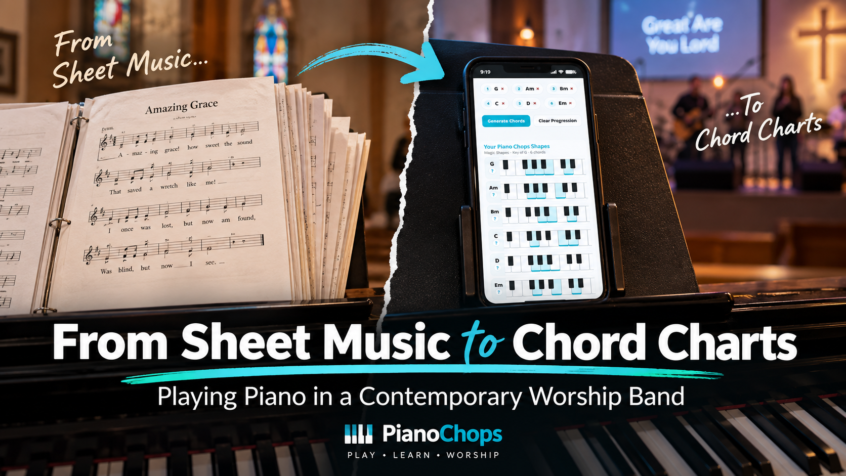
Traditional Hymns and Contemporary Worship Are Two Different Worlds
What happens when you’re a confident sheet-music player…and suddenly you’re sitting at the piano with drums, bass, guitars, keys and a worship team around you?
I recently received a great question from a piano player who has spent years playing from sheet music—mostly classical music and traditional hymns.
Her church had traditionally kept its contemporary band and hymn-based music somewhat separate. Recently, the groups were combined into one full worship band with drums, bass, guitars, keyboard, piano and singers.
And suddenly, she found herself asking a very important question:
What am I supposed to play?
She was accustomed to having full sheet music in front of her—sometimes six to nine pages for a single song. But in this new band setting, she was discovering that simply playing the written piano part didn’t always work.
The sheet music might be in a different register from what the band was doing. The singers might change the melody slightly. Keys could even change during the Sunday morning rehearsal, leaving very little time to relearn several pages of notation before the service.
She had begun experimenting with chord charts, but that was a completely different way of thinking than what she had learned.
So she asked for my opinion.
Well…she asked for it…so I’m going to give it to her. : )
Traditional Hymns and Contemporary Worship Are Two Different Worlds
Traditional hymns and contemporary worship require different skills and techniques.
Think about it the other way around.
If you took a traditional hymn and gave a piano player nothing but a basic chord chart, would it really sound like the hymn is supposed to sound?
Probably not.
The notation of a hymn moves in ways that a simple chord chart can’t fully express. There are moving voices, harmonies, bass lines, passing notes and all kinds of musical information happening inside that written arrangement.
Contemporary worship has the opposite problem.
If you take a fully notated piano arrangement and try to play every note exactly as written while drums, bass, guitars, keys and singers are all doing their jobs, you may actually be playing too much.
I think a lot of traditional piano players try to hold onto the notation for as long as they possibly can.
I understand why.
It’s comfortable. It’s what you know. And abandoning seven pages of music for one little chord chart can feel like somebody just took away your safety net.
But if you really want contemporary worship to start feeling natural, at some point you have to make that scary jump toward thinking mostly in chords.
So What Should the Piano Player Actually Play?
For contemporary worship with a full band, I would focus on two main things:
If there is a specific piano part…
Learn it and play it. Maybe it’s an intro, instrumental line, interlude or recognizable piano riff. That’s your moment. Play it confidently.
If there isn’t…
Play simple chords to the rhythm and relax. You don’t have to fill every available inch of musical space.
There is already a LOT happening. You’ve got drums. Bass. Guitars. Vocals. Maybe another keyboard. You don’t have to play everything.
In a traditional hymn setting, the piano or organ may be one of the primary forces driving the congregation.
In a full contemporary band, the piano often becomes more of a texture within the overall sound.
You’re a piece of the puzzle.
And that should actually give you some peace.
You don’t have to drive the boat the entire time!
There may be a Sunday when you have an important piano intro on one song…and for most of the rest of the set, you’re simply adding beautiful chord textures and supporting the rhythm of the band.
That’s not “doing less.”
That’s playing your role.
Stop Being Afraid of the Chord Chart
Here’s where things can get really fun.
If you can train yourself to think in Nashville Numbers, eventually you won’t care nearly as much when somebody changes the key.
Instead of seeing:
Now the progression itself is the information.
If the worship leader changes the key, the musical idea hasn’t changed. You just move those same numbers into the new key.
You can have one simple chart with your Nashville Numbers and maybe a few handwritten notes about an intro, interlude or special musical moment.
That’s much closer to the way I personally function when I’m playing contemporary worship.
And it’s a LONG way from trying to manage 7 PAGES OF MUSIC!!!
GULP!!
What If Your Chord Shapes Were Right on the Music Stand?
This is one of the reasons I’ve been developing tools that help piano players make the transition from simply reading chords to actually seeing and playing useful contemporary chord shapes.
Instead of a stack of sheet music, imagine having the progression in front of you with the actual piano shapes you need to play.
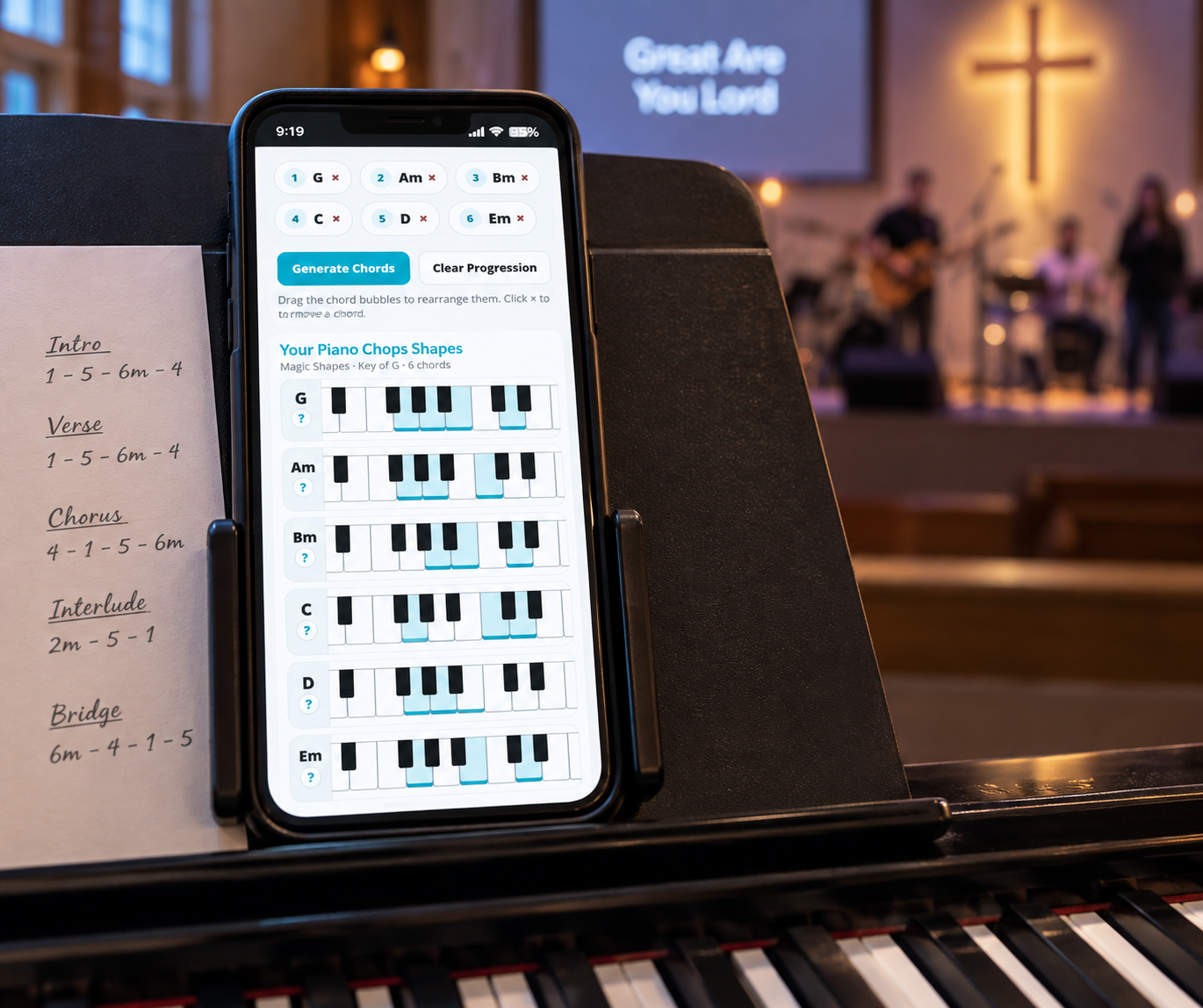
On a phone, I designed the generator so that you can have up to six chord shapes visible at once.
Choose your key. Build the progression. Choose the chord system you want. Put your phone on the music stand.
And play.
The goal isn’t to stare at a generator forever.
It’s to use it as a bridge while your hands and ears begin learning these patterns for themselves.
Eventually, those shapes start becoming part of your chops.
Want Some Help Making the Jump?
Piano Chops members can use three resources I created specifically for this kind of contemporary worship playing.
Magic Shapes
Learn repeatable right-hand chord formations that make moving through common worship progressions much easier.
Learn Magic Shapes →Anchor Pinky
Learn another system for creating smooth contemporary chord voicings through the diatonic chords of a key.
Learn Anchor Pinky →Magic Shapes & Anchor Pinky Generator
Enter your progression, see the shapes in any key, and switch between the two systems to find the sound that works for your song. The Nashville Numbers are included too!
Open the Chord Generator →My Advice? Make the Jump.
If you’re a traditional sheet-music player moving into contemporary worship, my suggestion is:
Make the jump.
Start getting comfortable with chord charts.
Learn to think in Nashville Numbers.
Learn a handful of great chord shapes.
Play the important piano-specific parts when the song calls for them.
And when it doesn’t?
Play the chords. Lock into the rhythm. Listen to the band.
And relax.
You don’t have to play everything.
In fact, learning what not to play may be one of the most important skills you develop.
And if someone asked me the opposite question—”I’ve only played contemporary worship from chord charts, and now I need to play traditional hymns”—I’d probably give them the opposite advice:
You’d better start learning to read that notation if you don’t want to pull your hair out. : )
They’re two different musical worlds.
The goal isn’t to decide which approach is better.
The goal is to develop the chops you need for the music you’re actually being asked to play.
Keep moving forward.
You can do it!
— Wade